 FORGE
Imbalances
The imbalance zones ICT looks at besides the FVG: inverted FVGs, FVG overlaps, gaps between bodies and opening gaps.
What it measures
Besides the FVG, ICT traders look at other zones where price left an imbalance. This indicator marks five:
- the Inversion FVG (IFVG): an FVG that a candle fully crosses and that changes role;
- the Balanced Price Range (BPR): a bullish and a bearish FVG close together whose zones overlap;
- the volume imbalance (VI): the gap between the bodies of two consecutive candles;
- the NDOG and the NWOG: the opening gaps of the day and of the week.
Each zone is a box with its own life: it forms, price touches it, and it gets filled or invalidated.
It’s a Pro plan indicator. It marks what has happened; it isn’t a recommendation or a buy or sell signal.
How it’s calculated
- The starting FVG: three candles. It’s bullish if the low of the third is above the high of the first, and bearish the other way round. It is known when the third closes. Minimum size: “Minimum FVG size” (1 tick by default). The candles are those of “Time frame of the FVGs (for IFVG and BPR)”, which is “The chart’s” by default.
- IFVG: an FVG that a closed candle fully crosses, that is, closes beyond its far edge (below it, for a bullish FVG; above it, for a bearish one). It changes role with the same prices: the inverted bullish FVG becomes a bearish (sell) zone and the bearish one a bullish (buy) zone. It forms on the candle after the one that inverts it, and the box starts at the middle candle of the FVG.
- BPR: a bullish and a bearish FVG with no more than 30 candles between their middle candles (“Maximum candles between the two FVGs”) and whose zones overlap by at least 1 tick. The zone is the overlap and its side is that of the more recent FVG. Each FVG is paired with the nearest overlapping opposite FVG that already existed. It forms when both are known.
- Life of an IFVG or a BPR: it is touched when price re-enters the zone; it is filled when a closed candle closes beyond the other edge (below the zone, if it’s bullish; above it, if it’s bearish).
- VI: two consecutive chart candles, already closed, whose bodies don’t touch but whose wicks do (if the wicks don’t touch either, it’s an FVG, not a VI). The zone is the gap between the bodies, of “Minimum size” (1 tick by default) or more. It forms on the candle after the second one, and the box starts at the first. It is touched when price enters it, and filled when a candle crosses it entirely, even with its wick.
- NDOG and NWOG: the gap between the close of the last candle of the previous trading day (from 6:00 pm to 5:00 pm New York time) and the open of the first of the new one; for the NWOG, with the week, which starts on Monday. From 1 tick counts (“Minimum gap size”). They are reference levels: they aren’t filled and run to the last candle. They form when the first candle of the period opens.
- How many are shown: the 10 most recent of each type among IFVG, BPR and VI (“How many of each type (IFVG, BPR, VI)”), the filled ones too, up to where they were filled; and 5 NDOG (“How many NDOG”) and 4 NWOG (“How many NWOG”).
- How far back it looks: the last “Days back” with candles (3 by default), plus a margin for the previous weeks.
- Nothing repaints: a zone forms when the candles that make it are closed, and what happens to it afterwards (the touch, the fill) is the first time it happens.
How to read it
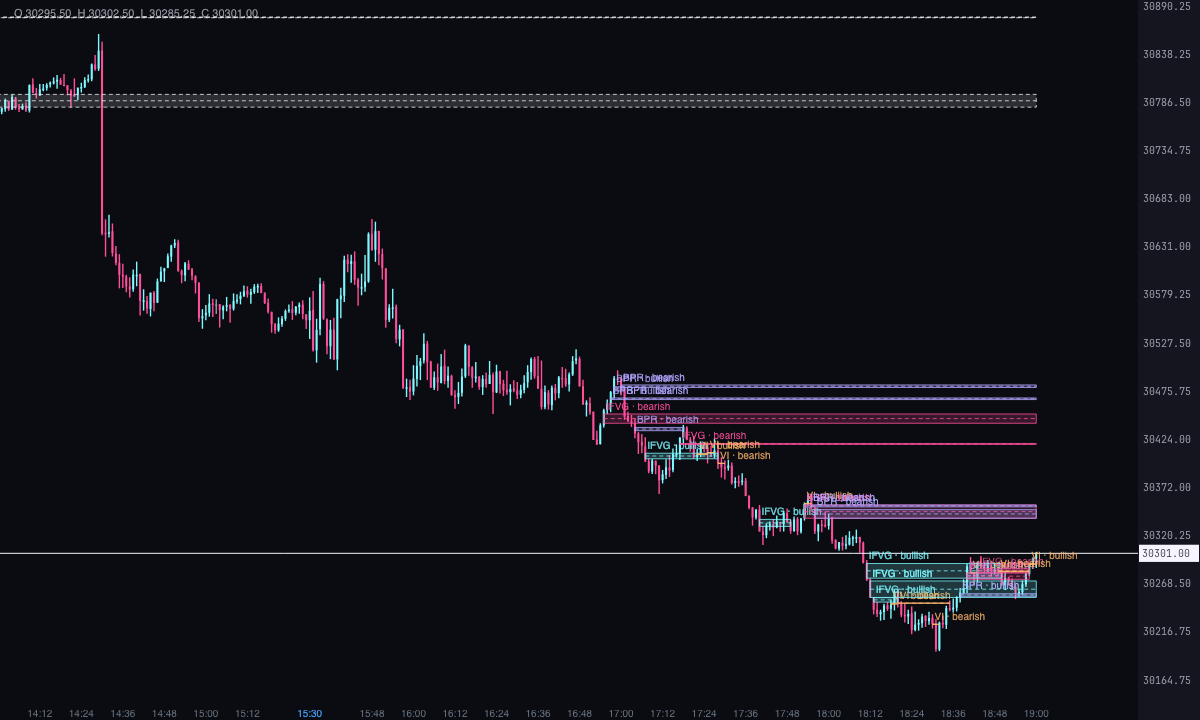
- Each zone is a box with its name and side at the top left, outside the box (IFVG · bullish, BPR · bearish, VI · bullish). On the NDOG and NWOG, only the name.
- The default colors: IFVG bullish in ice and bearish in pink; BPR in violet; VI in orange; NDOG in light grey and NWOG in orange. The opening gaps have a dashed border.
- A dashed line marks the midpoint of the zone (CE, “Draw the midpoint (CE)”).
- With “Cut each zone when it is filled or invalidated”, the box ends at the candle where the zone gets filled; without it, it runs to the last candle. Opening gaps are never cut.
Which chart to put it on
The IFVG and BPR zones are calculated with the time frame you pick in “Time frame of the FVGs (for IFVG and BPR)”, which can be higher than the chart’s (5 minutes, 15 minutes, 30 minutes, 1 hour, 4 hours or daily). The volume imbalance and the opening gaps are always calculated with the chart’s candles.
Built-in strategies
What the indicator already has inside and can mark for you on the chart. They show what has happened; they are not recommendations.
Inversion FVG (IFVG)
On by default- What it marks
- A box with the prices of an FVG that a candle has fully crossed, with its role flipped: the bullish one becomes a bearish zone and the bearish one a bullish zone.
- Alert
- If you turn it on: an alert when a zone forms and another when price touches it, with optional sound.
- Turned on with
- “Inversion FVG (the FVG that is fully crossed and changes role)”, in Inversion FVG; the alerts, in Alerts.
Balanced Price Range (BPR)
On by default- What it marks
- A box on the overlap of a bullish and a bearish FVG that are close together, with the side of the more recent one.
- Alert
- If you turn it on: an alert when a zone forms and another when price touches it, with optional sound.
- Turned on with
- “BPR (a bullish and a bearish FVG that overlap)”, in Balanced Price Range; the alerts, in Alerts.
Volume imbalance (VI)
On by default- What it marks
- A box on the gap between the bodies of two consecutive candles whose wicks do touch.
- Alert
- If you turn it on: an alert when a zone forms and another when price touches it, with optional sound.
- Turned on with
- “Volume imbalance (gap between the bodies of two candles)”, in Volume imbalance; the alerts, in Alerts.
NDOG (opening gap of the day)
On by default- What it marks
- A box between the close of the last candle of the previous trading day and the open of the first of the new one, running to the last candle.
- Alert
- If you turn it on: an alert when a zone forms and another when price touches it, with optional sound.
- Turned on with
- “NDOG (opening gap of the day)”, in Opening gaps; the alerts, in Alerts.
NWOG (opening gap of the week)
On by default- What it marks
- The same with the week: from the close of the last candle of the previous week to the open of the first of the new one.
- Alert
- If you turn it on: an alert when a zone forms and another when price touches it, with optional sound.
- Turned on with
- “NWOG (opening gap of the week)”, in Opening gaps; the alerts, in Alerts.
Adding it to the chart
In the chart bar, Indicators ▾ › More Indicators…. You’ll find it in the ICT category. It’s a Pro plan indicator. How to add and adjust an indicator is in Indicators.
Settings
Open them with the ⚙ on its row in Indicators ▾. All times are New York time.
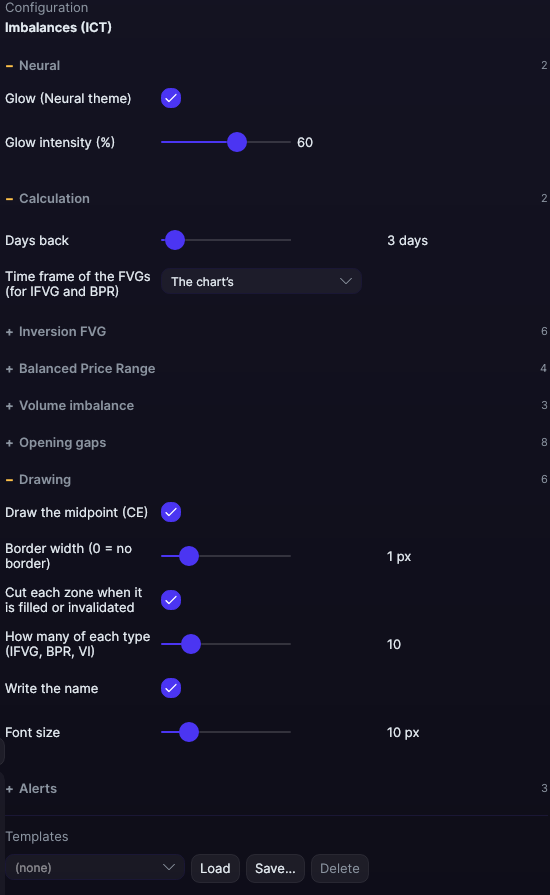
| Setting | Default | Range |
|---|---|---|
| Calculation | ||
| Days back | 3 days | 1 to 60 |
| Time frame of the FVGs (for IFVG and BPR) | The chart’s | The chart’s · 5 minutes · 15 minutes · 30 minutes · 1 hour · 4 hours · Daily (trading day) |
| Inversion FVG | ||
| Inversion FVG (the FVG that is fully crossed and changes role) | Yes | |
| Minimum FVG size | 1 ticks | 0 to 200 |
| Bullish fill | 7.80008e+08 | |
| Bullish border | 3.43081e+09 | |
| Bearish fill | 7.88484e+08 | |
| Bearish border | 3.43928e+09 | |
| Balanced Price Range | ||
| BPR (a bullish and a bearish FVG that overlap) | Yes | |
| Maximum candles between the two FVGs | 30 candles | 2 to 500 |
| Fill | 8.67215e+08 | |
| Border | 3.43413e+09 | |
| Volume imbalance | ||
| Volume imbalance (gap between the bodies of two candles) | Yes | |
| Minimum size | 1 ticks | 1 to 50 |
| Color | #FFB86B | |
| Opening gaps | ||
| NDOG (opening gap of the day) | Yes | |
| NWOG (opening gap of the week) | Yes | |
| Minimum gap size | 1 ticks | 0 to 200 |
| NDOG fill | #E6EDF3 | |
| NWOG fill | #FFB86B | |
| Color of the borders and midpoint of the gaps | #E6EDF3 | |
| How many NDOG | 5 | 1 to 30 |
| How many NWOG | 4 | 1 to 20 |
| Drawing | ||
| Draw the midpoint (CE) | Yes | |
| Border width (0 = no border) | 1 px | 0 to 6 |
| Cut each zone when it is filled or invalidated | Yes | |
| How many of each type (IFVG, BPR, VI) | 10 | 1 to 50 |
| Write the name | Yes | |
| Font size | 10 px | 6 to 30 |
| Alerts | ||
| When a new one forms | No | |
| When price touches it | No | |
| With sound | No | |
| Neural | ||
| Glow (Neural theme) | Yes, when added | |
| Glow intensity (%) | 60% | 0 to 100 |